Garnet House

Garnet HouseGarnet HouseGarnet House
Home
Six Salamanders Book List
The Memorandum Book
About
Contact
Events

Garnet House

Garnet HouseGarnet HouseGarnet House
Home
Six Salamanders Book List
The Memorandum Book
About
Contact
Events
More
  • Home
  • Six Salamanders Book List
  • The Memorandum Book
  • About
  • Contact
  • Events
  • Home
  • Six Salamanders Book List
  • The Memorandum Book
  • About
  • Contact
  • Events

About the Authors

Portrait of two elderly men in dark clothing, one holding a quill pen.

Jacob and Wilhelm Grimm

Jacob Grimm, (1785–1863)

Wilhelm Grimm, (1786–1859)


They are known for their endearing fairy tales that have captured imaginations, stolen hearts, and edified generations for centuries.


Read more about them here:

https://en.wikipedia.org/wiki/Brothers_Grimm


AI Overview


Jacob and Wilhelm Grimm were 19th-century German academics who compiled and published one of the most famous collections of folklore in history, Children's and Household Tales (commonly known as Grimm's Fairy Tales). Rather than writing the stories, the brothers collected traditional oral tales to preserve German cultural heritage. [1, 2, 3, 4]


The Life of the Brothers

Born a year apart in Hanau, Germany—Jacob in 1785 and Wilhelm in 1786—the brothers shared a famously close bond. Their father's unexpected death in 1796 plunged the family into poverty, forcing both to take on heavy responsibilities at a young age. They both studied law at the University of Marburg, but soon shifted their focus to their true passion: philology, linguistics, and medieval literature. [1, 2, 3, 4, 5]


Folk and Fairy Tales

The brothers' most famous contribution began as a scholarly project designed to safeguard German cultural identity during a period when the region was politically fragmented. They published the first volume of Kinder- und Hausmärchen in 1812. Over the next several decades, they released seven expanding editions. Wilhelm, who had a softer and more literary touch than his older brother, continually honed the stories, transforming them from raw oral histories into the polished, globally recognized classics we know today. [1, 2, 3, 4, 5, 6]


Beyond Fairy Tales

While their fairy tales are universally celebrated, the brothers were primarily pioneering linguists and scholars: [, 2]

  • The German Dictionary: They began work on the massive Deutsches Wörterbuch, the first comprehensive dictionary of the German language.
  • Grimm's Law: Jacob formulated a foundational rule in historical linguistics known as Grimm's Law, which explains the consonant shifts in Germanic languages. [1, 2, 3]


Wilhelm passed away in 1859, followed by Jacob in 1863. Their tireless work laid the foundation for the modern study of folklore and shaped the cultural identity of Germany. [1]For an accessible deep dive into the true historical origins of their stories and who the brothers really were:Related video thumbnail30mthan Fairy Tales: The True Story behind the Brothers Grimm | Full DocumentaryI Love DocsYouTube · Sep 10, 2024To explore the details of their legacy and the impact of their original, much darker early editions:Related video thumbnail5:13"The Brothers Grimm: A Biography"WGN News

Grimms' Fairy Tales, 1812

AI Overview

The original Grimm's Fairy Tales, published in 1812 by German scholars Jacob and Wilhelm Grimm, were not intended for children. They were dark, scholarly collections of oral folklore. The early stories featured intense themes like cannibalism, mutilation, and biological mothers (who were later changed to stepmothers in sanitized versions). [1, 2, 3, 4, 5]


History of the Original Collection

In December 1812, the brothers released their first volume, Children's and Household Tales (German: Kinder- und Hausmärchen). This initial edition featured 86 stories. A second volume with 70 additional tales followed in 1815. [1, 2, 3, 4, 5]Their goal was to preserve German cultural history, so the texts were written with raw, spare storytelling and academic footnotes rather than as pleasant bedtime stories. Over the next 40 years, the Grimms published six more editions. They heavily revised, cleaned up, and expanded the tales to make them more family-friendly, morally instructive, and commercially successful. [1, 2, 3, 4]


Differences Between Original and Modern Versions

Modern popular culture—largely shaped by Disney adaptations—presents a highly sanitized version of these classics. The 1812 and 1815 editions were much more gruesome. For example: [1, 2, 3]

  • Cinderella: In the original, the stepsisters hack off parts of their own heels and toes to make the golden slipper fit, and magical birds pluck out the stepsisters' eyes at the wedding. [1, 2]
  • The Girl Without Hands: In the early 1800s version, a father cuts off his own daughter's hands. In later editions, this was heavily altered. [1, 2, 3]
  • Snow White: The wicked Queen was punished by being forced to step into red-hot iron shoes and dance until she dropped dead. [1]


Exploring the Early EditionsTo read exactly how these classic tales were first written before they were edited for children, scholars have translated the initial 1812 and 1815 editions into English. [1, 2]You can read the original English texts through these digital archives:

  • Explore the translated 1812/1815 texts in The Original Folk and Fairy Tales of the Brothers Grimm.
  • Read the complete 1812/1815 English translation on Princeton University Press or Project Gutenberg.
  • View public domain stories from the unrevised early English translations at CMU School of Computer Science. [1, 2, 3]


Would you like to know how specific tales—like Rapunzel or Hansel and Gretel—differed between the original 1812 edition and the versions we know today?

About the Authors

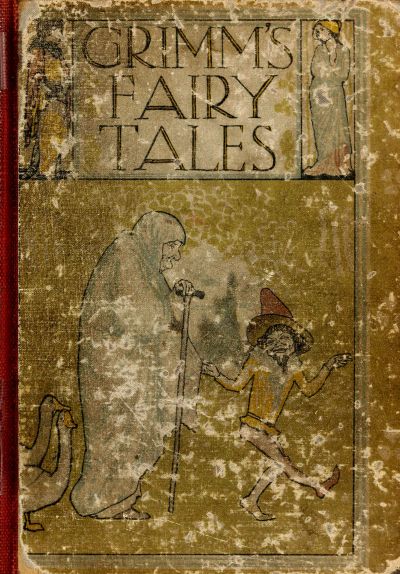
Brothers Jacob and Wilhelm Grimm

About the Books

https://en.wikipedia.org/wiki/Grimms%27_Fairy_Tales

Read the Original

https://archive.org/details/grimmscompletefa00grim/mode/2up

Read the Project Gutenberg Digital Transcription

https://www.gutenberg.org/cache/epub/2591/pg2591-images.html

Listen to the Audiobook

https://www.youtube.com/watch?v=m8JvmtxjC1M

Listen to the 1978 Animated Adaptation of The Three Golden Hairs

https://www.youtube.com/watch?v=C-MNh49SMBU

About the Movies

Brothers Grimm

Film Adaptations


AI Overview


Film adaptations of the Brothers Grimm fairy tales bring classic, often dark stories to life. Some films stay true to the original, gloomy folklore. Others turn the tales into family-friendly adventures. [1, 2, 3, 4]Top Brothers Grimm adaptations include:

  • Snow White and the Seven Dwarfs (1937): The classic animated movie. It set the standard for "happily ever after".
  • Into the Woods (2014): A film that mixes different tales like Cinderella, Rapunzel, and Little Red Riding Hood. It explores the heavy consequences of storybook wishes.
  • Gretel & Hansel (2020): A dark, spooky horror film that takes the siblings into a creepy forest and an isolated witch's home. [1, 2, 3, 4, 5]
  • The Brothers Grimm (2005): A fantasy movie starring Matt Damon and Heath Ledger. It imagines the folklore collectors as traveling con artists who battle a real magical curse. [1]
  • Snow White: A Tale of Terror (1997): A dark R-rated gothic movie starring Sigourney Weaver. It ditches singing dwarves for a scary, realistic look at the evil stepmother. [1]


Read more about the film adaptations here:

https://en.wikipedia.org/wiki/Category:Films_based_on_Grimms%27_Fairy_Tales


Watch 5 Trailers: 

Red Riding Hood; Hansel & Gretel: Witch Hunters; Maleficent; Cinderella, and Snow White and the Huntsman

https://www.youtube.com/watch?v=JgaccxYNfXo


Read About & Watch the Movies: Section in process...

Snow White

Snow White

Snow White

  1. Read About: 
  2. Watch theTrailer:
  3. Watch the Movie: 
  4. Learn the horrific history: https://www.youtube.com/watch?v=BSZkKM_AjU0

1982

Snow White

Snow White

  1. Read About: 
  2. Watch the Trailer: 
  3. Watch the Movie: 
  4. Learn the horrific history: https://www.youtube.com/watch?v=fb_tHA1Uudk

Copyright © 2019 Lori Alayne Way and Garnet House  LLC. 

All Rights Reserved.

Powered by

  • Six Salamanders Book List
  • The Memorandum Book
  • About
  • Contact

This website uses cookies.

We use cookies to analyze website traffic and optimize your website experience. By accepting our use of cookies, your data will be aggregated with all other user data.

Accept